The first regional Tashkent Water Week brought something into focus for me that I’d been circling for a long time.
I came to Tashkent to host two important water-themed conversations. I’m leaving with a much bigger question, and a new role.
Two essential conversations in two venues
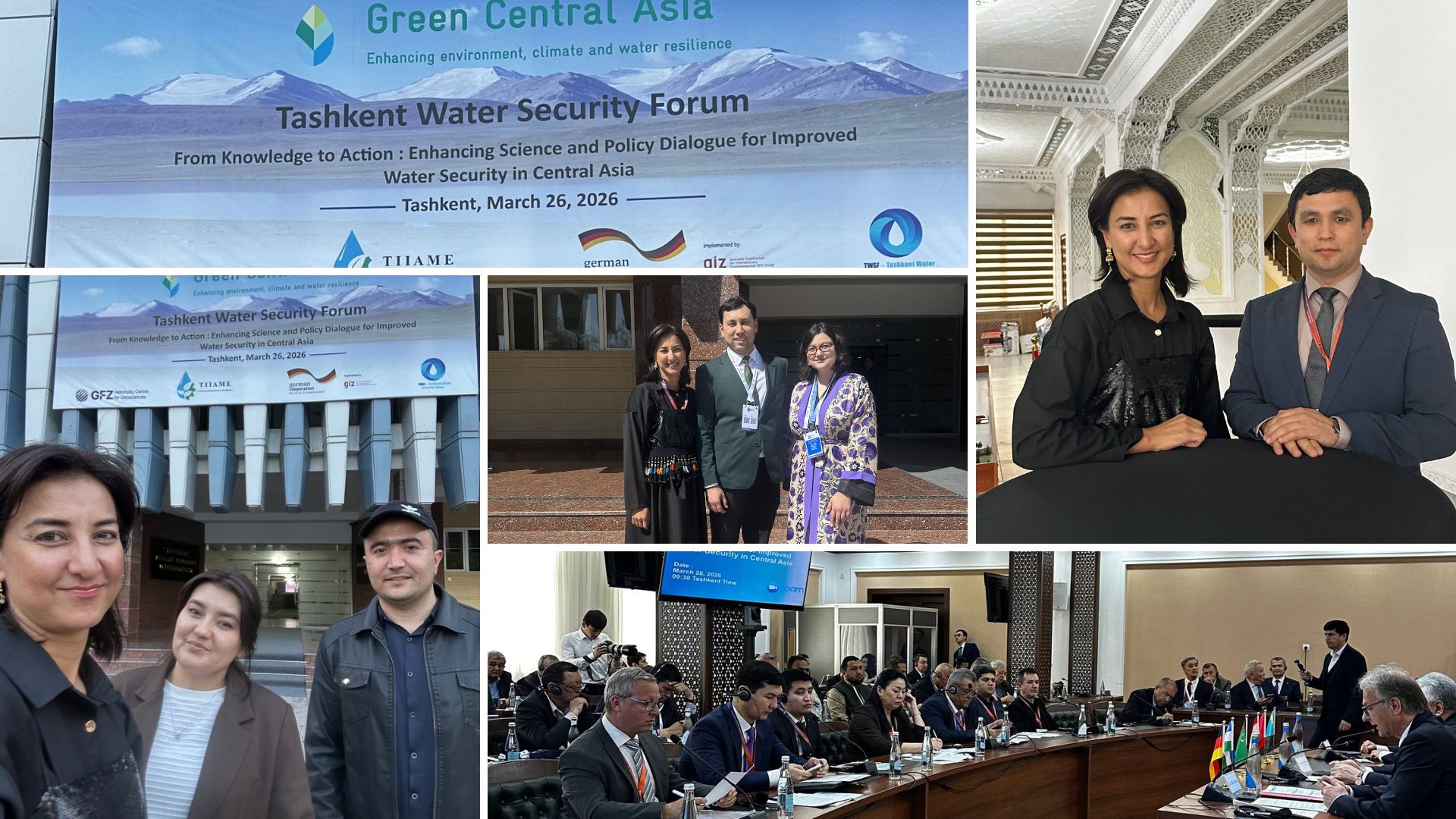
As the first-of-a-kind government-organised regional Tashkent Water Week, the room was unlike any I had hosted before. On stage, I welcomed ministries and investors. Glacier scientists and irrigation engineers. International development organisations, finance solution providers and development banks. Participants from 19 countries. And something unique: 80 women drawn from universities and regions across Uzbekistan, brought into the policy dialogue through the Women in Water programme.
The agenda was urgent and concrete: regional water scarcity, cross-sectoral collaboration, financial frameworks, capacity building, and how to translate global water conventions into regional and national targets, without losing the people they’re meant to serve.
A few numbers, shared across the week by Sabine Machl at Tashkent Water Week, Abror Gafurov at the 8th Tashkent Water Security Forum, and a few days later by Anders Johansson, CTO of Grundfos Group, at Executive Day Denmark in Copenhagen, which I also had the pleasure of hosting:
- 2.2 billion people globally lack access to safely managed drinking water.
- 703 million, roughly 1 in 11, lack clean water at all.
- Women and girls spend an estimated 250 million hours every single day walking to collect water, often 6 kilometres per trip.
- More than 1,000 children under five die every day from water-related diseases. One every two minutes. Roughly 1.4 million child deaths a year.
- In Central Asia alone, 82 million people live with water insecurity. 10 million have no safe drinking water at all.
- Around 80% of Central Asia’s river flow comes from glaciers and snowmelt, and we could lose half of the remaining glacier cover within 25 years. 95% of water in the region goes to agriculture; the remaining 5% covers drinking, sanitation, and everything else.
Sitting in that room with decision-makers and experts, hearing these numbers spoken aloud rather than read on a page, I realised how much I still had to learn about the scale of what we are facing.
Why moderation is about translation, not transmission
Here is what I keep saying to organisers, and what I’ll say again here:
A high-level convening is not the outcome. The outcome is what the people in the room are able to share, what they dare to question, and the calls to action they arrive at together; calls that improve the quality of their work, their solutions, and above all, their collaboration across borders.
The urgency of this water summit was unmistakable. My job was to translate content and context across disciplines and cultures, guiding the conversation across sectors and giving every voice balanced time to speak; not to pitch, but to be genuinely mindful of the impact that collective regional work can bring.
Some of the most meaningful feedback came from academics in the audience. They told me I had helped connect speakers, researchers and practitioners in a way that made them feel united in one room; heard and seen across science, policy and practice.
I noticed something else as I moved through the room. When I approached people with questions, not everyone was used to speaking up. I see this often in my cross-cultural work: in collective societies where power distance is high, people are less likely to speak on their own behalf, especially in front of a senior audience. In Finland, by contrast, most people will happily share their subjective view of the content. Neither approach is right or wrong, but as a moderator, you have to know which room you are in, and adjust how you invite people in.
Quietly, in the breaks and the hallways, I approached participants from Central Asia and they opened up; sharing stories, taking selfies, even following me on Instagram afterwards. That is relational work. In more collective societies, people are not as task-focused as they are relationship-focused, and building rapport means a great deal. I spent a long time speaking with participants after the sessions, and those were some of the most rewarding conversations of the week.
One small moment stayed with me. The interpreters had been translating all day long, and I bumped into one of them in the hallway. She said to me with great conviction:
“It was such a pleasure to translate what you said. It was easy to follow, good pace; thank you for making my job so easy and enjoyable.”
These are the kind of human-to-human moments we seriously need to cherish. I loved that she felt safe enough to say it.
And from Professor Abror Gafurov, host of the 8th Tashkent Water Security Forum:
“You delivered a good event as if you were a water expert and knew the right jargon. I travel to many global conferences, and you did it with a lot of enthusiasm. Well done!”
Preparation is the quiet part of this work
Before Tashkent, I worked with Iteca Exhibitions through the speaker briefs, the formats, the running orders, the audience and the regional context. I prepared from home in Qarshi, where, happily, the internet worked seamlessly. I helped create a red thread that ran from the first day of Tashkent Water Week into the next day’s 8th Water Security Forum. I shaped questions that were usable, not ornamental.
The feedback I received from TIIAME National Research University and the Tashkent Water Week organisers came down to one consistent line: she came prepared. Razor-sharp on timing. Razor-sharp on content. And firm in challenging the room, because this is no business as usual.
Preparation is the quiet part of this work. It is the work of staying flexible with both organisers and speakers, aligning everyone, and making sure each person walks into the room feeling fully ready and comfortable.
What the week actually revealed
If I had to name the central problem of the week in one sentence, it would be this:
We do not have a knowledge gap. We have a communication gap.
There is no shortage of science. Glaciers are studied. Hydrology is mapped. Engineers already know how to remove heavy metals from industrial water, the Finnish company Epse is doing exactly that. Swiss firms are building cross-border solutions. Investors are watching closely, and some are now pitching financing instruments. Slovakian water experts brought their EU experience and a clear can-do attitude.
What is missing is the connective tissue of aligning priorities through proper communication:
- Between scientists and policy makers, who too often speak past each other.
- Between ministries, where agriculture alone consumes 95% of regional water use, and the private sector, where most of the innovation sits.
- Between transboundary neighbours, whose borders are political but whose rivers are not. (One detail that has stayed with me: Afghanistan is currently outside the major regional water conventions, despite sharing rivers with everyone around it.)
- Between the experts in the room and the schoolchildren whose generation will live with the consequences. Ask yourself: how much do any of us actually learn about water hygiene, or about how to reuse and recycle it?
I felt this last gap most acutely when I delivered a master class at a local university in Qarshi, bringing students from different schools into the conversation. They were inspired. They were also a little provoked. Their question was the most honest of the week:
“Why aren’t we already talking about water? It’s a daily reality in our families.”
There is almost no curriculum that meets young people where they are on water. (If you’re a teacher reading this and you’ve found material that works, please send it to me. I am quietly collecting it, including from a wonderful Finnish teacher I recently connected with on Instagram.)
This translation gap is the same one I hear about from CTOs at Executive Day Denmark, where water was the opening keynote, because data centres are now water-intensive industries, and water is becoming a national security and cyber-security concern, not just a sustainability one. The CTOs were asking the same question Tashkent was:
“How do we explain risk to boards in a language they can act on?”
This is the work of a moderator, a facilitator, a community-builder. It is also, increasingly, the work of a consultant.
Why I’m now an Associate Partner at Savvy Advisory
Tashkent made something else clear: the most useful thing I can offer this region is not just the stage. It is what happens before and after the stage.
That is why I’ve recently joined Savvy Advisory as Associate Partner.
The role is a natural extension of what I already do. Beyond speaking and hosting, it allows me to bring my network into partnerships and to run projects across borders. It lets me sit with organisations between events, brokering the right cross-sector conversations and building the kind of mutual trust that helps regional cooperation actually speak the same language, and move forward together.
If you are an organisation working across Finland, the Nordics, Uzbekistan or wider Central Asia, and you want to convene something that matters, let’s talk.
A note on water and time
The United Nations recognised access to safe drinking water and sanitation as a human right in July 2010, through General Assembly Resolution 64/292. Not the 1980s. Not the 90s. 2010. Within most of our adult working lives.
That fact alone tells you something about how slowly policy moves compared to the climate.
In Saudi Arabia, according to Awaad Al Otaibi, CEO of the publicly listed Miahona company, around 60% of water and 40% of wastewater treatment is privately operated. In Helsinki, water is so reliable we forget it exists. In Tashkent and in my home region of Kashkadarya, every household I know stores water, because cuts are routine.
The privilege of water access shapes what we can imagine. So help me keep water at the centre of the conversation. We need a water workforce: hydrologists, glacier scientists, policy makers fluent in science, and teachers with material they can actually use. And we need everyday consumers, you and me, who understand that climate-resilient behaviour is not someone else’s job.
The question I’m leaving you with
The same one I left in the room in Tashkent:
“You have just spent two days in a high-level forum. What are you going to do differently for the next two or three years to make this event worth it?”
This is the question that separates a meaningful convening from an expensive one. I’m building a practice around answering it, on stage, with teams, in boardrooms, and now alongside Savvy Advisory.
If you’re working on something in this space, or you simply want to think out loud about water, regional cooperation, or what good convening can do, my inbox is open. 💙
With gratitude to the organisers of Tashkent Water Week, the Iteca partners, the team at TIIAME National Research University, the GFZ (German Research Centre for Geosciences) team, the International Institute of Central Asia, and the colleagues from 19 countries who made the week what it was.
To learn more
A few tools, voices and resources worth following:
- MODSNOW: a regional cryosphere monitoring tool used across Central and South Asia. Read more here.
- What is happening with water in Europe? Here’s a short video worth watching.
- Follow Dinara Ziganshina on LinkedIn.
- Follow Abror Gafurov on LinkedIn.