Reflections on the WBCSD / FIBS Global Business Breakthrough Barometer 2026 launch, and what it takes to move Finnish business from defense to offense on climate transition.
From the moderator’s chair: a piece on foresight, four industry cases, three panel voices, and the disorderly transition nobody wants to name out loud.
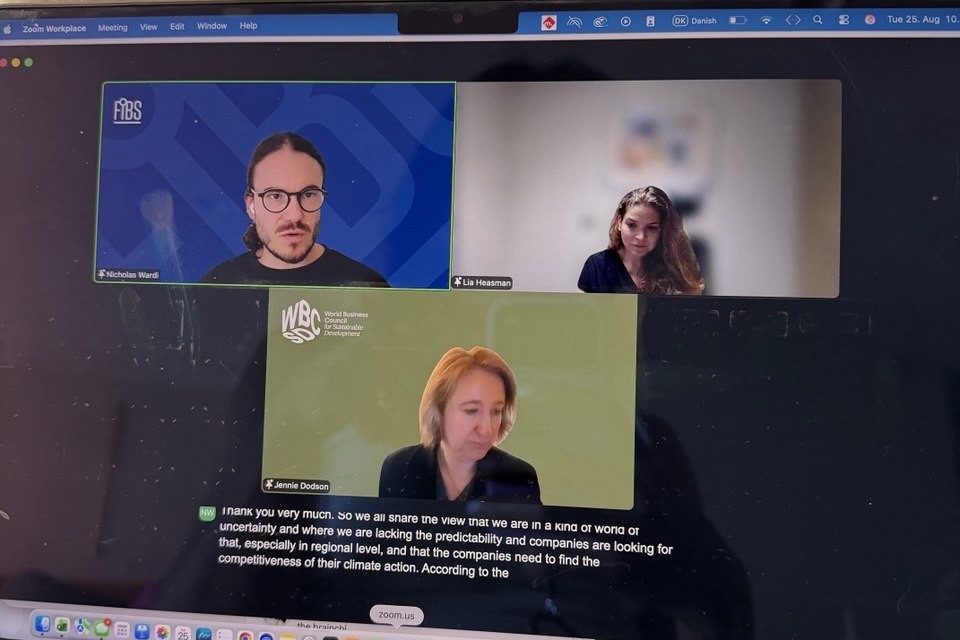
Yesterday I took part in the online launch of the WBCSD / FIBS Global Business Breakthrough Barometer 2026, a survey on how Finnish companies see the climate transition.
Here is the catch.
85% of Finnish businesses believe sustainability is a serious competitive advantage over the next 5–10 years. That is almost matching the global rate of 92%.
So far, so good.
But look at why companies actually act, and the picture shifts sharply.
In Finland, sustainability strategy is driven primarily by:
- Resilience and risk management – 63% vs. 51% globally.
- Customer demand – 61% vs. 32% globally.
- Reputation and social license to operate – 55% vs. 33% globally.
And future growth opportunities? Only 24% cite it as a driver, half the global rate of 48%.
In plain terms: Finland is playing defense. Protecting what we have. Responding to pressure. Guarding reputation. Meanwhile, the rest of the world is starting to treat sustainability as offense, a way to grow, not just to survive.
To be fair to the sceptics: caution is not irrational. Capital costs money, regulation has been unstable, and nobody wants to be the company that moved a year too early. But caution and paralysis are not the same thing, and Finland’s numbers suggest we have drifted closer to the second than we would like to admit.
Four Brakes on Renewal
Deloitte and Demos Helsinki named this pattern precisely in their “Better Is Possible” report earlier this year, pointing to four recurring brakes on renewal inside Finnish organisations:
- Low-ambition targets – governance stays comfortable. “Nobody had asked for a higher target in a while,” as one interviewee put it.
- Risk avoidance over opportunity-seeking – the report asks the question that stings: “Is anyone held responsible for missed opportunities?”
- Closing doors on diverse voices – as the report bluntly notes, “spicy dialogue is required to make courageous decisions.”
- Efficiency over renewal – transformation gets treated as a project with an end date, not a lasting capability.
Naming the brakes is easy.
The real question: who has the power to release them, and how fast?
Foresight as Discipline, Not Decoration
I remember during lockdown, when webinars were suddenly everywhere, that Risto Siilasmaa, founder of F-Secure and Nokia’s chairman through its 2012–2020 turnaround, kept advocating for the same thing: scenario planning is not a slide in the strategy deck. It is a discipline.
Renewal happens when someone in the room has the authority to act before certainty arrives, not after.
That is the muscle Finnish leadership needs to keep building.
When Growth Happens Anyway: Four Industry Cases
If the theoretical argument does not land, the industry evidence should.
Texas built one of the fastest-growing renewable markets in the US, not from climate conviction, but from raw demand. Data centres and electrification pushed consumption so high the state needed generation from every source, and renewables were simply the fastest and cheapest to build. Wind and solar now supply around 30% of the grid.
SSAB turned decarbonised steel into a premium product, not a cost centre. Their HYBRIT technology produced the world’s first fossil-free steel, and they built it straight into premium brands like Hardox and Strenx, commanding a margin instead of just avoiding a fine.
Yara partnered with Lantmännen to bring fossil-free fertilizer to market, cutting its carbon footprint by 80–90%. They targeted high-value crops deliberately, because premium segments can absorb the premium price green production requires.
Outokumpu’s Kemi mine, the only chromite mine in the EU, is on track to become the world’s first carbon-neutral mine, cutting emissions equivalent to removing 4,000 cars from Finnish roads a year. Outokumpu now calls their own chrome supply “a competitive advantage,” not a liability. Decarbonising the raw material lets them credibly sell their stainless steel as low-emission from mine to finished product.
None of these companies led with idealism. They led with a clear-eyed read of where margin and demand were heading, and moved early enough to own the position.
That is what offense looks like.
Voices from the Panel
Back to the launch event.
Nicholas Wardi and Heli Karhi kicked off the discussion by sharing that Finnish businesses are alert to the climate transition but feel under-prepared, calling for early, predictable, framework-led policy action to give companies a stable runway.
A strong panel picked up the thread from there.
I asked a question alongside another participant on scenario planning and future foresight, specifically, how sustainability professionals can strategise for the climate transition more effectively. The answer that came back was clear: there is hope and mandate for sustainability professionals, particularly those with future-foresight skills, who can keep a sharp focus on the business case and speak fluently in the language of numbers and strategy.
Two responses in particular stayed with me.
Lia Heasman, Ph.D. | Responsible Investment Director at A. Ahlström:
“Stop bolting sustainability onto the side. Go back to basics, what’s the actual advantage, what does nature really cost us if we get it wrong. And find your new crew: sit with the finance people building the evaluation models. As sustainability becomes a real building block of strategy, you need people who can calculate it, not just talk about it.”
Jennie Dodson, Ph.D. | Senior Director at WBCSD:
“Preparedness beats prediction.”
She described how at WBCSD’s annual meeting, companies role-played C-suite decisions through economic, geopolitical, and physical-risk shocks, not to forecast the future, but to build the muscle for whatever shows up. And, importantly, “it’s never just your own choices that matter, it’s how everyone around you reacts too.”
Both answers pointed to the same underlying truth: the winners will not be the ones with the best forecast. They will be the ones with the best-built teams, the best-integrated finance and sustainability functions, and the most disciplined foresight practice.
My Moderator’s View from the Room
I have moderated conferences where the conversation swings, in a single hour, from futurist thinking to geopolitics to cybersecurity to climate risk.
A few things become impossible to unsee when you do this work often enough.
Diversity on the board is not a nice-to-have. It is structural. It is how you catch risks before they arrive and how you avoid group think, which is the quiet enemy of every organisation that stops asking uncomfortable questions of itself.
The best sustainability case in the world falls flat if it is spoken in a language only specialists understand. The strongest version always carries two halves: the case for acting, and the cost of not acting, or the cost of delay. I repeat: cost of action and cost of inaction. That is the balance every sustainability leader needs to be able to pitch in three sentences to a C-suite or a board. The rest is noise.
(Worth naming: I make part of my living moderating exactly these conversations, so take that as the context it is.)