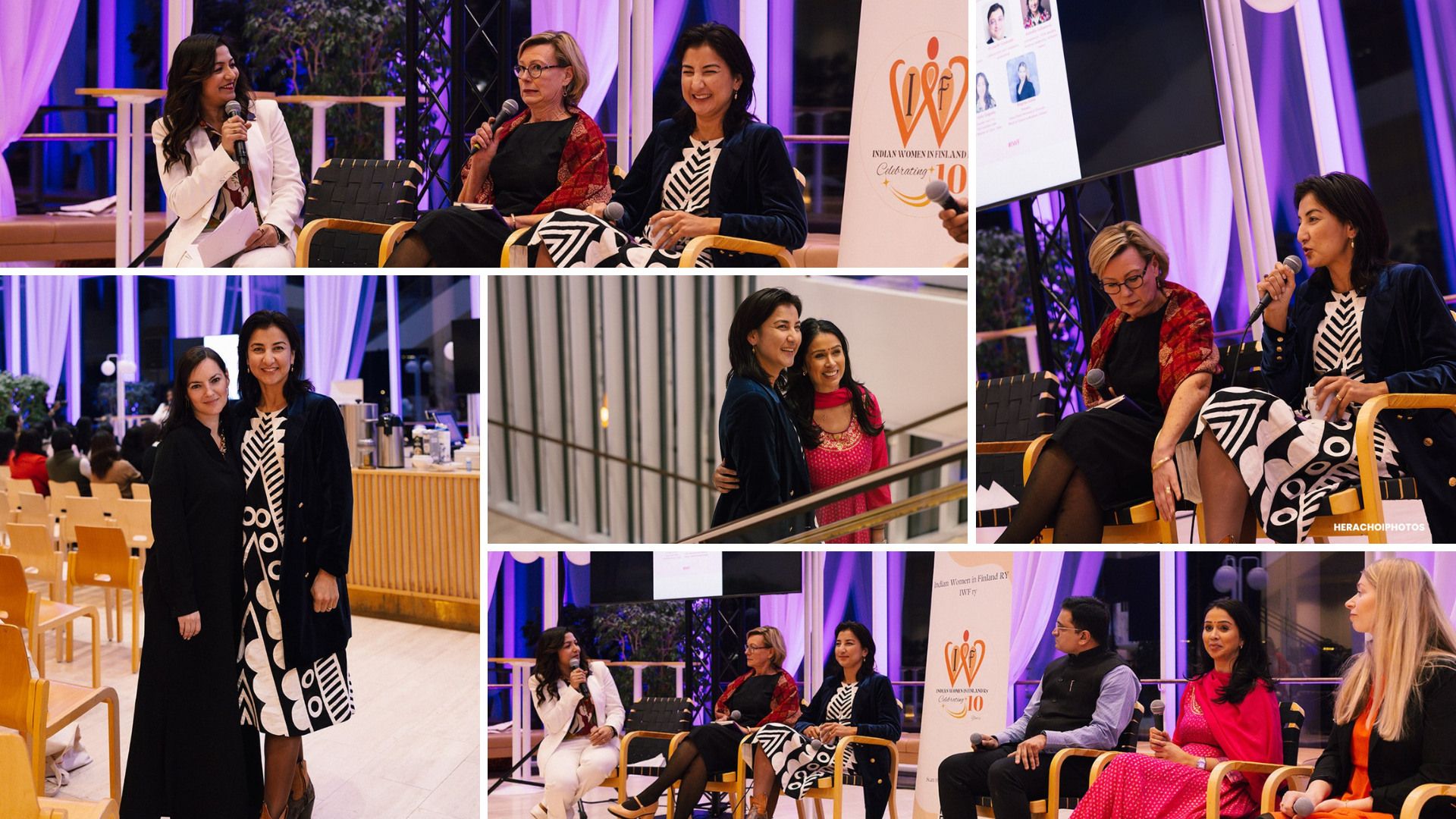
A reflection on joining the panel discussion with Indian Women in Finland Ry, and what it means to take the seat next to the microphone, not the one in front of it.
In my line of work, most engagements involve me holding the room – as a host, as a moderator, as a keynote speaker.
But every so often, the most useful thing I can do is sit down, take a seat on a panel, and be a good guest in someone else’s conversation.
That is exactly what I was honoured to do at the Indian Women in Finland Ry panel discussion on mentoring and leadership, alongside the remarkable Sofiya Utge, Vaishali Doshi and Ramya Sriram.
It is a different craft. And it is one I take seriously.
Why this engagement mattered to me
Indian Women in Finland Ry is one of the strongest and most active women’s communities in the country. They are not a casual network. They are a determined, well-organised, high-trust community of professionals who lift each other into leadership positions, mentor each other through career transitions, and keep showing up for each other across generations.
When a community like that invites you onto their stage, the right answer is yes – quickly, gratefully, and with proper preparation.
I said yes for three reasons.
One, mentoring and leadership are subjects I work on every day. I host rooms about them. I consult organisations on them. I have lived the receiving end of mentoring as an immigrant-origin professional in Finland, and I now sit on the giving end of it more often than not. I had something real to bring.
Two, I believe deeply in supporting communities that do the slow, unglamorous work of holding professional women together across cultures. Indian Women in Finland Ry does that work beautifully.
Three, sitting on a panel is craft work I want to keep practising. The best moderators are also good panellists , and the best panellists know how to make the moderator’s job easier, the audience’s job clearer, and the other panellists’ contributions sharper.
What being a good panel guest actually requires
People underestimate panel work. They assume you arrive, sit down, answer questions, and leave.
The truth is closer to this: a good panel is the result of four or five people doing invisible preparation, and one moderator weaving it together in real time. When the prep is missing, the panel is forgettable. When the prep is there, something memorable happens.
Here is what I bring to a panel seat:
1. I prepare as if I were moderating it. I read the brief. I read the other panellists. I think about which voice in the conversation I am best positioned to add, and which voice I should make space for instead. I arrive with three or four genuinely useful contributions in mind, and the discipline to leave most of them unsaid if the room doesn’t need them.
2. I listen as much as I speak. The mark of a strong panellist is not how much airtime they take. It is how often the moderator turns to them because the answer is going to land. Panels are won in the listening, not in the talking.
3. I lift the other panellists. When Sofiya, Vaishali or Ramya said something sharp, my job was to build on it, not compete with it. A good panel is a relay race. Anyone who treats it as a sprint is the reason the audience tunes out.
4. I respect the moderator’s design. Because I moderate panels myself, I know how much invisible architecture goes into a 45-minute conversation. As a panellist, my job is to make that architecture work, not to wander off the structure because I have a favourite anecdote.
5. I bring my full identity to the seat. Multilingual. Multicultural. Mother. Immigrant-origin Finn. Professional who has had brilliant mentors and who now mentors others. I do not flatten any of that to fit a panel format. I let the audience see the whole person, because that is what makes the answers usable.
What the conversation reminded me about mentoring and leadership
A few things stayed with me from the discussion that are worth naming here:
Mentoring is a leadership skill, not a side activity. The leaders who scale tend to be the ones who built the people who came after them. The leaders who plateau tend to be the ones who saved their best thinking for themselves.
Mentoring across cultures is its own discipline. What works in one cultural context can quietly fail in another. The mentors who succeed across cultures are the ones who ask more than they advise, and who treat the mentee’s context as the thing being designed for.
The invisible mentors matter most. Most of the women in that room had been quietly carried forward by someone who never called themselves a mentor. That is the work that does not appear in any leadership textbook, and it deserves more recognition than it gets.
Communities like Indian Women in Finland Ry are leadership infrastructure. They are not networking groups. They are the underlying infrastructure that allows international professional women to build durable careers in Finland. Treating them as anything less is a mistake.
What this engagement says about how I work
If your organisation is considering booking me, the Indian Women in Finland Ry panel is a useful reference point, particularly for what it shows about my values and approach.
1. I show up for community organisations with the same seriousness I bring to paid bookings. The work either has my full preparation or it doesn’t. There is no middle setting.
2. I work fluently across cultures and across formats. Hosting, moderating, keynote speaking, panel guesting, consulting – each requires its own muscle. I have spent years building all of them, and I know which one your event actually needs even when you are still figuring it out.
3. I support women, professionals and communities of practice as a deliberate part of how I work. Not as PR. Not as branding. As a core working principle that shapes my calendar.
4. I bring substance to leadership and mentoring conversations. Both are central to my consulting practice with organisations on community-building, leadership culture and how teams actually become teams.
What I do and what I bring to the rooms I’m hired for
I work as a multilingual event host, moderator, facilitator, keynote speaker, panel guest, and organisational community-building consultant across the Nordics, Central Asia and beyond.
I am a strong fit for organisations and communities that are looking for:
- A panellist who lifts the conversation rather than dominating it, useful in leadership panels, equality panels, women-in-business forums, intercultural dialogues, and community gatherings.
- A keynote speaker who can address sophisticated international audiences with substance and warmth.
- An event host or moderator who can hold complex, multilingual, cross-cultural rooms with care.
- A facilitator and consultant for organisations that want their workplace to feel like a real community, not a structure people merely report to.
If that sounds like the room you are building, I would love to hear from you.
A final thank you
To Indian Women in Finland Ry for the invitation and the trust. To my fellow panellists Sofiya Utge, Vaishali Doshi and Ramya Sriram, for sharp thinking, generous listening, and the kind of conversation that stays with you long after the panel ends. And to every woman in the audience who came to learn, contribute, or simply be in a room of others like her.
Rooms like that one are how leadership actually gets built.