A reflection on delivering the keynote at Elisa’s Sustainability Day, and what it takes to make the strategic case for inclusion in front of a corporate audience that has heard every version of it before.
I will not pretend.
I do not speak about inclusion as often as I used to.
In a landscape dominated by AI, tech disruption, geopolitics and cybersecurity, DEI has slipped down the priority list, especially in a tight economic climate where short-term efficiency wins the conversation. Budgets have been cut. Programmes have been quietened. Some leaders have stopped using the word entirely.
That is exactly why Elisa’s Sustainability Day stood out.
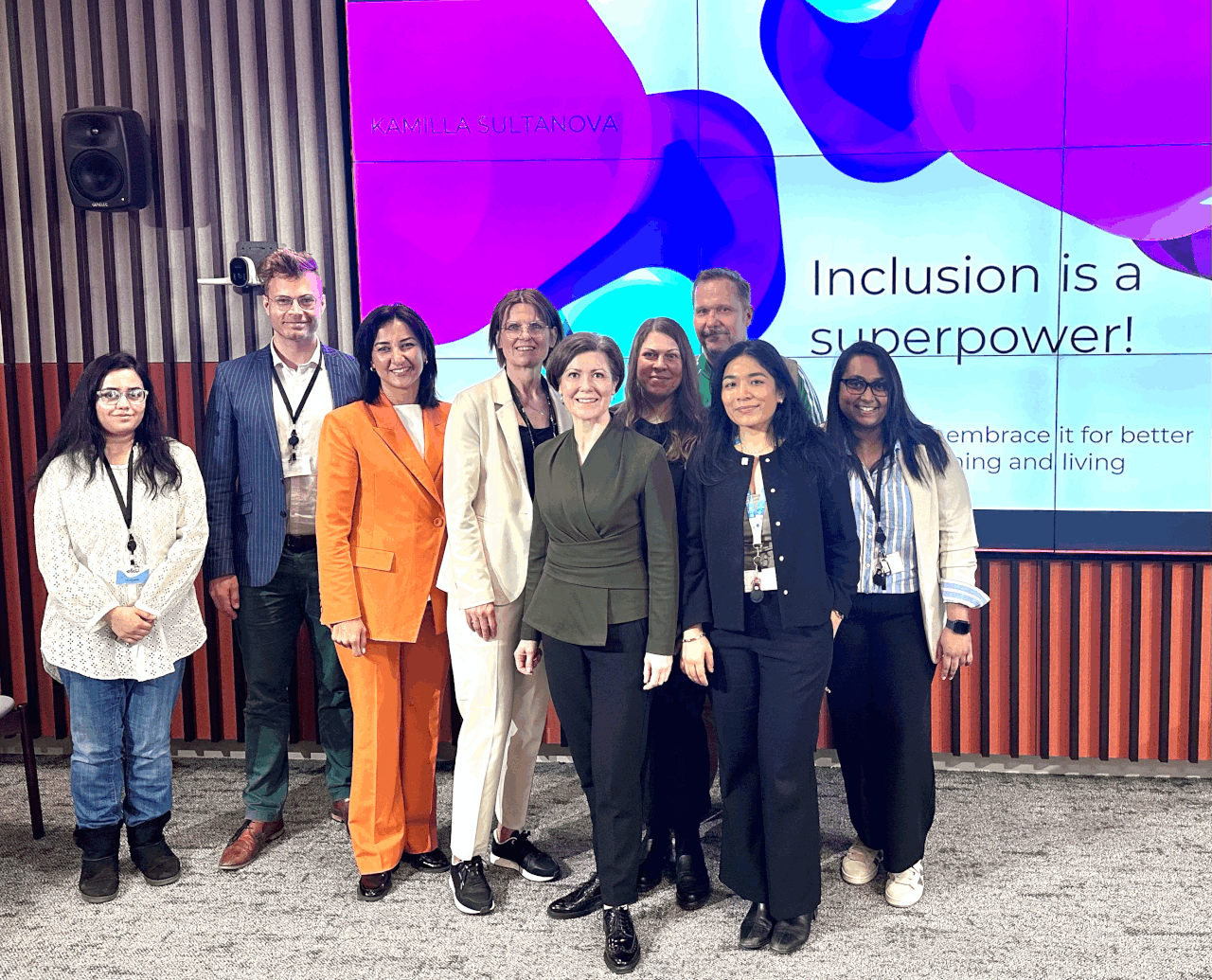
In a year when most corporate calendars are stepping back from the topic, Elisa put it firmly back on the agenda, and treated it as a strategic enabler of performance, not as a side conversation. Kati Nyman, Corporate Chief of Staff, was in the room. That signal alone said something the rest of us in this field have been waiting to hear.
I was honoured to be the keynote speaker.
What the room actually needed
When you give a keynote on equality and inclusion in 2026, you are walking into a room that has heard every version of the talk before.
The empowerment version. The compliance version. The morality version. The case-study version. The data version.
A senior corporate audience does not need any of those again. What they need is a strategic, business-literate, performance-grounded argument, delivered by someone willing to be honest about the headwinds and confident enough to make the case anyway.
That was the brief I gave myself walking in.
What I covered on stage
The keynote made one core argument: done well, inclusion is both business-critical and individually empowering. It sharpens the execution of core business goals, and at the same time builds each professional’s capacity to lead, stay resilient, and sustain belonging across borders and stakeholder groups.
A few of the threads we worked through:
Inclusion lives in two places at once. It starts in the architecture, processes, systems and practices, but it is realised through everyday leadership: the continuous decisions and behaviours that either enable or erode company values. You cannot solve one without the other. Most organisations do half the work.
Where it typically breaks down. Lack of ownership. Lack of funding. Lack of people resources dedicated to the work. We named these honestly, because pretending otherwise has not served the field.
What leaders can actually do at the micro level. Allyship. Demonstrated benefits and incentives. Linguistic inclusion. Meeting etiquette. Feedback giving. Fair career advancement. Small-leverage behaviours that, repeated across thousands of decisions, change how a company actually feels to work in.
Why this is not a soft conversation. When treated as a disciplined, data-informed, measured part of organisational development, this work improves how people work, how they earn, and ultimately how they live. That is a business case any leadership team can recognise, if it is delivered with the seriousness it deserves.
The line that stayed with me
A few weeks earlier, at a Kipinä Software breakfast, Teemu Linna, CTO of Agion, said something I have not stopped quoting since:
“It is 10% about technology and 90% about people.”
That sentence is, in my view, the entire executive summary of the next decade.
If leadership teams stay focused on the conditions that help people collaborate, trust and include one another, the technology – and the results – will follow. The reverse is not true. You can buy any technology stack on the market and still fail, if the people layer is broken.
That is the strategic argument I am taking into every corporate keynote I now give.
The ecosystem behind the keynote
It was a particular pleasure to reconnect at the event with Sudina Shrestha, a Hanken School of Economics alumna I worked with through the Hanken International Talent programme, and with Saku Tihveräinen, a long-time collaborator in the Talent Boost ecosystem.
Their presence in the room reminded me of something I keep returning to: impact in this field is built over years, through cross-sectoral collaboration. Cities, universities, companies, non-profits, it takes a full ecosystem to make this work tangible. No single keynote, no single programme, no single leader does it alone.
When organisations book me, they are not just booking a speaker. They are tapping into a decade of relationships across the Nordic and international talent, equality and leadership ecosystem.
What this engagement says about how I work
If your organisation is considering booking me as a keynote speaker, particularly in a moment when the topic feels harder to address than it used to, the Elisa Sustainability Day keynote is a useful reference point. Here is what it makes visible:
1. I make the strategic case, not the moral one. Senior corporate audiences do not need to be lectured. They need to be given a sharp, business-literate argument they can take into the next budget conversation. That is the kind of keynote I build.
2. I am data-informed and disciplined. I treat equality and organisational development as a measurable, structured field, not as a feeling. That framing matters to executives, and it changes the kind of decisions a keynote can unlock.
3. I work across the architecture and the everyday. Most speakers stay at one level: either the systems argument or the leadership-behaviour argument. I bridge both, because the real change happens when an organisation works on them simultaneously.
4. I am honest about the headwinds. I do not pretend the climate for this work is what it was three years ago. Naming the difficulty earns the audience’s trust, and earning that trust is the precondition for any useful conversation that follows.
5. I bring an ecosystem, not just a speech. A decade of cross-sectoral work across the Nordic and international talent landscape, universities, companies, public sector, non-profits, sits behind every keynote I give. Organisations book the speech and quietly inherit the network.
6. I close with action, not inspiration. A keynote that ends in applause and changes nothing is a keynote that has wasted the audience’s afternoon. I design the closing minutes specifically for what leaders should do on Monday morning, not on a future strategic horizon.
What I do and what I bring to the rooms I’m hired for
I work as a multilingual event host, moderator, facilitator, keynote speaker, panel guest, and organisational community-building consultant across the Nordics, Central Asia and beyond, and as Associate Partner at SavvY Advisory.
For corporate keynote bookings specifically, I am a strong fit when your organisation is looking for:
- A speaker who can address senior corporate audiences on equality, leadership, organisational development, belonging and the future of work – with a strategic, performance-grounded argument.
- A keynote that survives the headwinds, particularly useful at sustainability days, leadership offsites, town halls, and strategy events where the topic needs defending, not just celebrating.
- A multilingual, multicultural presence comfortable across English, Russian and Uzbek, fluent in Nordic and international corporate cultures.
- A speaker whose keynote can sit inside a longer engagement – a workshop, a facilitation day, a consulting project – when you want the speech to land and then keep working inside the organisation afterwards.
- A long-term partner for organisations that want to treat people-development as a measurable, disciplined part of how they operate.
If that sounds like the room you are building, I would love to hear from you.
A final thank you
To Minna Kröger, Anu Koivu, Tiina Raittinen and the Elisa Sustainability Day team for the invitation, the trust, and the courage to put this topic at the centre of a corporate sustainability conversation. To Speakersforum Finland for the long-running cooperation. To Kati Nyman for the leadership signal her presence in the room sent, and to every leader in the audience who came willing to engage. And to Sudina Shrestha, Saku Tihveräinen, and the wider Talent Boost and Hanken International Talent ecosystem, for being the kind of long-term collaborators who make this work possible across years and across sectors.
The challenge ahead is to scale this kind of impact even in demanding economic conditions, and even when polarisation pushes people further apart.
That challenge is exactly the work I am here for.