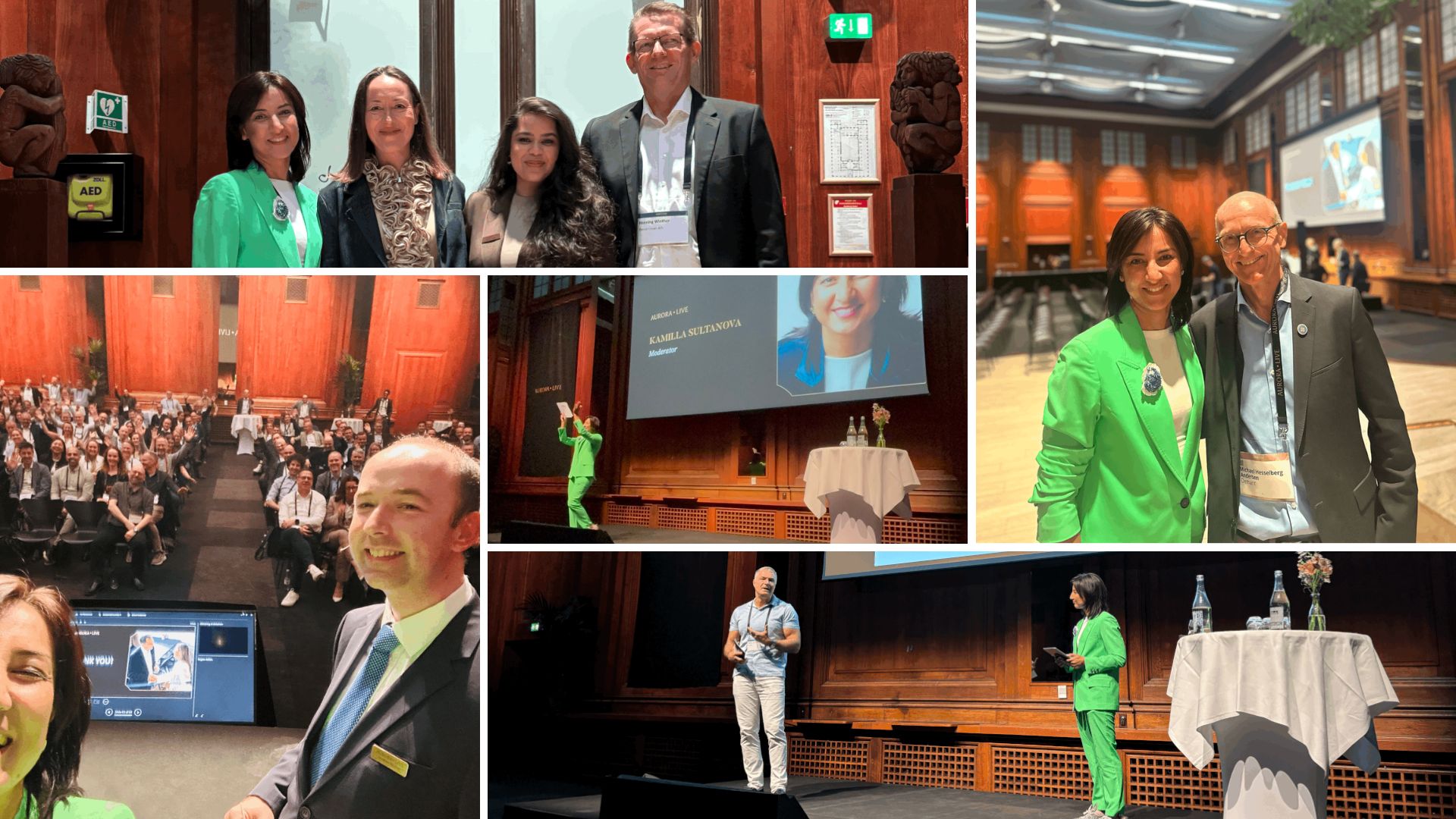
A reflection on moderating Aurora Live’s Executive Day in Copenhagen, and what it takes to hold a room of 200 senior tech leaders for a full day without losing the thread.
If you bring 200 senior tech leaders together for a full day, the conversations have to matter.
That was the standard I walked into Aurora Live’s Executive Day Denmark holding myself to. By the end of the day in Copenhagen, one observation had crystallised for me, and it now shapes how I think about almost every executive engagement I take:
The hardest part of tech leadership right now is not technology. It is translation.
That single framing turned out to be the red thread of the entire day.
The room
The audience was a senior Nordic and international executive network — CIOs, CTOs, and tech leadership running some of the most consequential digital infrastructure in the region. The brief was not “introduce the speakers.” It was: hold the room, keep the thread, and make sure 200 busy executives leave with something they can actually use.
The venue itself set the tone. Axelborg, a former bank turned agricultural HQ, designed by Arne Jacobsen, with food by Nimb Hotel, gave us a setting that felt simultaneously serious and unmistakably Danish. We opened with a flash-mob acapella from a Copenhagen choir group, which was as much a calibrated decision about audience energy as it was a moment of joy. (More on that below.)
What the speakers were really arguing about
On paper, the agenda covered five different topics. In practice, every speaker circled the same challenge from a different angle.
Anders Johansson, GRUNDFOS — translating water systems into cyber and national security risk. Water infrastructure is no longer just a sustainability conversation; it is a security one, and the boardrooms of the next decade need that translation now.
Niels Billekop, Arrow — translating AI assistants and “shadow tools” into real data exposure, and into the policies organisations actually need to govern them. The risk lives in the gap between what tools do and what leaders understand they are doing.
Henning Winther, Danish Crown — translating complex cyber risk into a language boards can own and act on. His emphasis on relationships over reporting structures was one of the most quietly important arguments of the day.
Signe Biering, Executive Coach — translating surface-level dynamics into the real tensions and emotions underneath them. Psychological courage as a leadership competency, not a wellness footnote. (A particular pleasure to meet her in person after following her work on LinkedIn for a long time.)
Bugge Holm Hansen, Copenhagen Institute for Futures Studies — translating foggy “future” talk into the discipline of working with several futures simultaneously, and being prepared for more than one of them.
Five speakers. Five disciplines. One job: make the technical legible to the people who have to decide.
That was the conversation I was there to keep alive across the day.
My job as moderator
A full day with 200 executives is not a sequence of panels. It is a single arc. And the moderator is the person responsible for the arc.
My goal was to do three things, consistently, from the opening flash-mob to the closing remarks:
Keep the translation thread alive. Every speaker session, every panel, every audience exchange – I steered the conversation back to the same underlying question: how do we translate what we know into what our boards, teams and stakeholders can act on? That coherence is what makes a one-day event feel like a strategic moment rather than five disconnected talks.
Give every participant a clear stake. A 200-person room can either feel like an audience or a community. The difference is engineered, not accidental. I designed the audience interactions, the questions and the transitions specifically to make sure people opened up, asked questions actively, and networked beyond their usual circles. Making an audience turn into a safe community is my personal success criteria.
Hold the energy across the full day. Tech executives do not need to be entertained. But they do need to be carried. A flash-mob acapella opening, a calibrated pace, well-timed humour, Finnish-Danish anecdotes that invited the network beyond Denmark, these are not flourishes. They are the working tools of full-day moderation.
Afterwards, a participant told me:
“You kept energy high through the day with humour, helped to deliver complex topics palatable for off-topic executives, and a good red thread of the content.”
That sentence is more or less the entire job description.
What this engagement says about how I work
It was a particular pleasure to reconnect at the event with Sudina Shrestha, a Hanken School of Economics alumna I worked with through the Hanken International Talent programme, and with Saku Tihveräinen, a long-time collaborator in the Talent Boost ecosystem.
Their presence in the room reminded me of something I keep returning to: impact in this field is built over years, through cross-sectoral collaboration. Cities, universities, companies, non-profits, it takes a full ecosystem to make this work tangible. No single keynote, no single programme, no single leader does it alone.
When organisations book me, they are not just booking a speaker. They are tapping into a decade of relationships across the Nordic and international talent, equality and leadership ecosystem.
What this engagement says about how I work
If your organisation is considering booking me to host or moderate a senior executive day, the Aurora Live engagement is a useful reference point. Here is what it makes visible:
1. I work the full day, not just the stage moments. A 200-person executive day succeeds or fails in the connective tissue between sessions, not in the sessions themselves. I treat the entire arc as the deliverable, and I prepare for it accordingly.
2. I translate across disciplines as a core craft. Tech, security, governance, futures, psychology, sustainability – the value of a moderator at this level is the ability to carry meaning fluently between worlds that do not usually share a vocabulary. That is increasingly rare, and increasingly needed.
3. I work fluently across Nordic and international executive cultures. Multilingual. Cross-border. At home in Helsinki, Copenhagen, Tashkent, and the global executive ecosystem. For audiences that span national contexts, that fluency is not a nice-to-have, it is the precondition for the room functioning at all.
4. I bring energy as a discipline, not as personality. Choir flashmobs, calibrated humour, well-timed cultural cross-references – these are deliberate tools. A senior tech audience can absorb more substance when the energy of the room is engineered carefully. That is moderator craft.
5. I work as a partner to the organisers. A successful executive day is a team sport. The smoother the relationship between host, organisers, speakers and venue team, the more freedom everyone has to deliver their best work. I treat the organising team as collaborators from the first briefing call onwards.
6. I close the room with something portable. Executives do not return to their teams quoting the agenda. They return quoting one or two ideas worth using. My job is to make sure those ideas are clean, sharp, and carried out the door, not lost in the closing minutes.
What I do and what I bring to the rooms I’m hired for
I work as a multilingual event host, moderator, facilitator, keynote speaker, panel guest, and organisational community-building consultant across the Nordics, Central Asia and beyond, and as Associate Partner at SavvY Advisory.
For executive day and leadership network bookings specifically, I am a strong fit when your organisation is looking for:
- A moderator for full-day Nordic or international executive networks – CIO/CTO days, leadership summits, member days, partner forums, and senior community gatherings.
- A host who can hold the arc of a full day in front of 100–500 senior decision-makers without losing energy, focus or substance.
- A multilingual, multicultural presence comfortable across Nordic and international executive cultures, fluent in English, Russian and Uzbek.
- A translator across disciplines – tech, sustainability, security, governance, futures, psychology, equality, leadership – for audiences that need the connections drawn for them, not just the content delivered to them.
- A long-term partner for executive networks looking for consistent moderation across recurring annual or quarterly engagements.
If that sounds like the room you are building, I would love to hear from you.
A final thank you
To the Aurora Live Executive Day Denmark team – and especially Tasnim Hossain, Sohvi, Olivia, Alexander, Christian Reuther and Philip Caserta – for the collaboration and the trust to hold the room. To the speakers – Anders Johansson, Niels Billekop, Henning Winther, Signe Biering and Bugge Holm Hansen – for sessions that gave the day a real spine. To the audience of 200 executives who showed up curious, engaged and willing to translate beyond their own departments. And to Axelborg, the Copenhagen choir group, Nimb Hotel and the venue team for making the day feel as good as it sounded.
Until next time.