A reflection on hosting the Women’s March 2025 in Helsinki, and what it taught me about the kind of moderator a sensitive room actually needs.
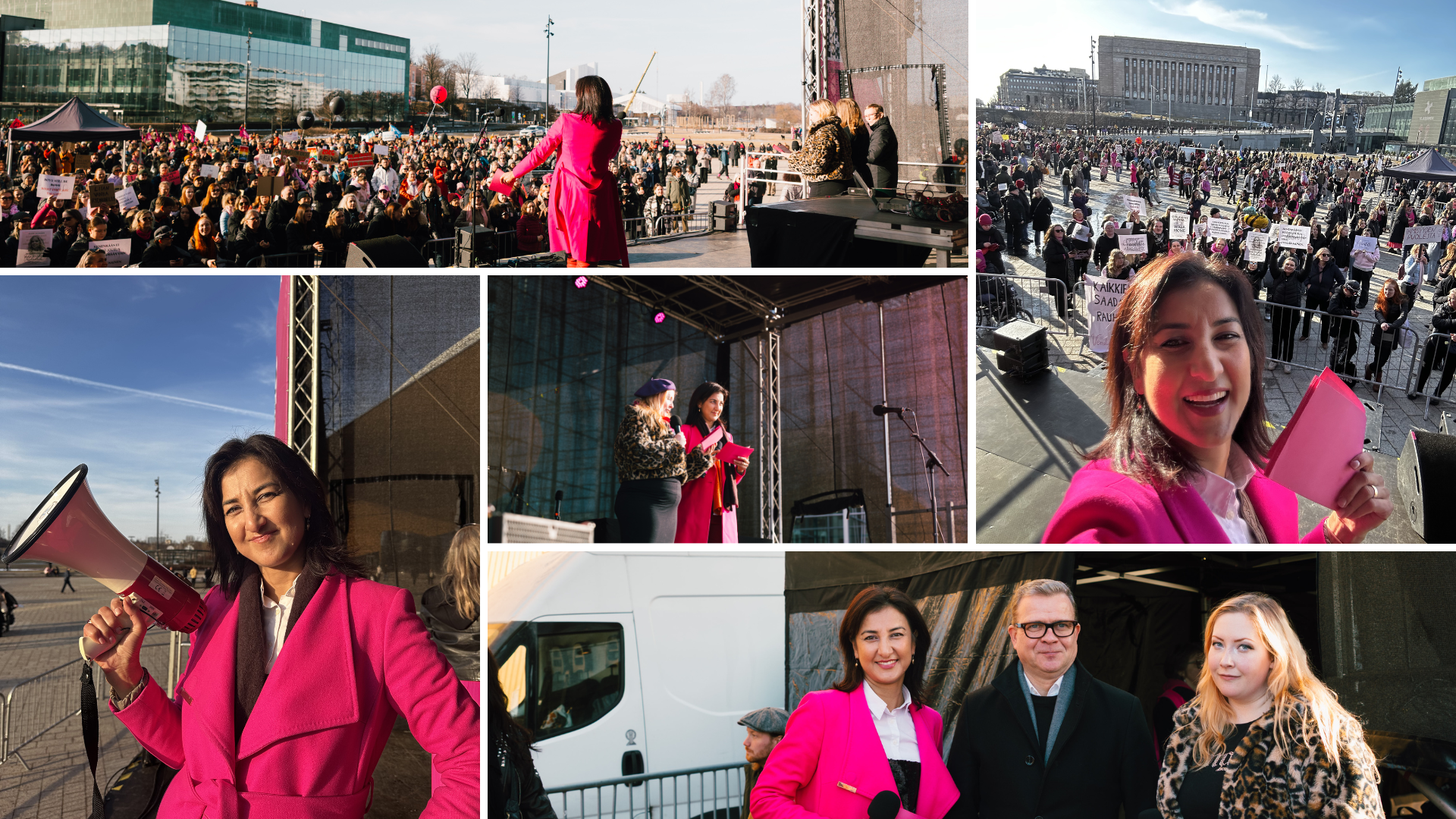
20,000 people on the streets of Helsinki. A grieving family handing a petition to the Prime Minister. Teenage girls, many of them in tears, standing together because they were tired of being unsafe. A lip balm thrown towards the stage mid-speech, and the split-second alertness that follows.
This was the Women’s March on International Women’s Day, 8 March 2026. I was honoured to host it, alongside my wonderful co-host, poet Rosanna Fellman, and vibrant fellow co-hosts Susanna Mahadura and Elina Gustafsson at the train station gathering.
It was the most powerful day I’ve experienced in my ten years of marching in Finland. And it was one of the most demanding rooms I’ve ever held.
I want to write about it carefully, because the same principles that shaped how I worked that day are the principles I bring to every stage I’m trusted with.
Why this engagement mattered to me
The invitation came from Jaana Hirsikangas and the team at UN Women Finland / Turunmaa Local Committee, and I do not take that kind of invitation lightly.
Hosting a march of this size and emotional weight is not the same as hosting a corporate forum or a CIO-CTO executive day. The brief is different. The risk is different. The responsibility is different.
You are not there to entertain. You are there to hold the room, for grief, for rage, for hope, for solidarity, and for 20,000 people who arrived with very different reasons for being there.
That is craft. And it is values. And it is preparation. And on the day, it is also nerve.
The moment that defined the day
The most emotional moment of the march came when a petition calling for concrete action to end violence against women was handed to Prime Minister Petteri Orpo.
It was delivered by Vilma and Saara Salminen, the sister and aunt of Vendi, a 15-year-old girl who never came home after being killed.
Many in the crowd were in tears. I was too. It is hard to even write these lines.
When you are the person holding the microphone in a moment like that, you have one job: do not get in the way of what the room is feeling. Do not perform. Do not over-produce. Do not rush the silence. Read the temperature, hold the timing, protect the speakers, and trust the people in front of you to do the rest.
That is what I mean when I say moderation is not a soft skill. It is judgment work, performed live, with no second take.
The teenage girls in the crowd
What struck me most this year was the sheer number of teenage girls marching.
Young voices. Young emotions. Young courage. Many crying. Many standing shoulder to shoulder. Many demanding a safer society in a country that prides itself on being one of the safest in the world.
If you ever wonder whether convening still matters in a digital-first, scrolling-first culture – look at those girls. They didn’t come to the march because of an algorithm. They came because someone built the room. Someone organised. Someone invited. Someone gave them a stage to stand near and a crowd to stand inside.
This is the case for hosting, facilitating, convening, and gathering people in the flesh. It will never be replaced.
What this engagement showed about the way I work
Looking back, the day distilled the values and craft I bring to every booking – paid or otherwise. If your organisation is considering working with me, here is what that day made visible:
1. I take preparation seriously – especially when the stakes are emotional. The bigger and more sensitive the room, the more invisible the preparation needs to be. By the time I’m on stage, the script is internalised, the timing is rehearsed, the speaker briefs are in my body, and I’m fully free to be present.
2. I work with the organisers, not above them. The trust between Jaana, the UN Women Finland team and me was the real foundation of the day. When organisers and host trust each other, the magic in front of the audience becomes inevitable.
3. I host across registers. On the same stage I had to honour grief, introduce the Prime Minister, hold space for a 15-year-old’s family, energise 20,000 people, and respond to an unexpected disturbance – all within the same flow. That tonal range is the whole job.
4. I represent diverse women, and I take that seriously. Being trusted to host and represent Finland’s diverse women on a day this important is not a gig I treat as transactional. It is a responsibility I prepare for as a woman, an immigrant-origin Finn, a mother, and a multilingual professional who has spent years building trust across communities.
5. I bring craft and values to the same room. You cannot fake your way through a march like this one. The audience knows. The organisers know. The speakers know. The work has to come from somewhere real.
What I do and what I bring to the rooms I’m hired for
Beyond moments like the Women’s March, I work as a multilingual event host, moderator, facilitator, keynote speaker, and organisational community-building consultant across the Nordics, Central Asia and beyond.
I am hired for stages where the conversation matters and the audience deserves more than a polished MC. That includes:
- High-stakes public events where tone, sensitivity and political awareness are non-negotiable.
- Corporate forums and executive days where leaders need a host who can read a room of senior decision-makers and shape the dialogue, not just announce the next speaker.
- International conferences requiring a multilingual host who can move between English, Russian and Uzbek with cultural fluency.
- Internal leadership offsites and strategy sessions where facilitation and trust are the actual deliverables.
- Long-term consulting engagements with organisations that want to turn their workplace into a real community – somewhere people show up because they want to, not because the calendar invite said so.
If you are organising something where the room matters, where the tone matters, and where the people in front of you deserve a host who has done the inner and outer work – I would love to hear from you.
A final thank you
To the incredible organisers, volunteers and speakers who made the Women’s March possible. To Jaana Hirsikangas and the UN Women Finland / Turunmaa Local Committee team for the invitation and for the trust. To my co-hosts Rosanna Fellman, Susanna Mahadura and Elina Gustafsson. To Hera (Haerang) Choi for the photographs. And to every woman, man, parent, teenager, ally, sceptic, marcher, speaker and signatory who showed up that day.
Judging by the voices on Helsinki’s streets, I believe we were heard.
Now the work continues.