A note on thought leadership, peer learning, and why some of the most strategic engagements on my calendar are the ones where I show up as a guest, not a host.
People sometimes assume that the way to spot a serious moderator or facilitator is by looking at the stages they’re booked on.
I’d argue the opposite.
Look at the rooms they show up to without an invoice attached.
The afterworks, the workshops, the podcasts, the panels they sit in as a participant, the conversations they choose to invest their unpaid Tuesday evenings in. That’s where you’ll see what they actually take seriously. That’s the calendar of someone who is still in motion as a thinker.
Here are four of mine from this season, and what each one is teaching me.
1. Podcast guest – Henley Business School Nordic
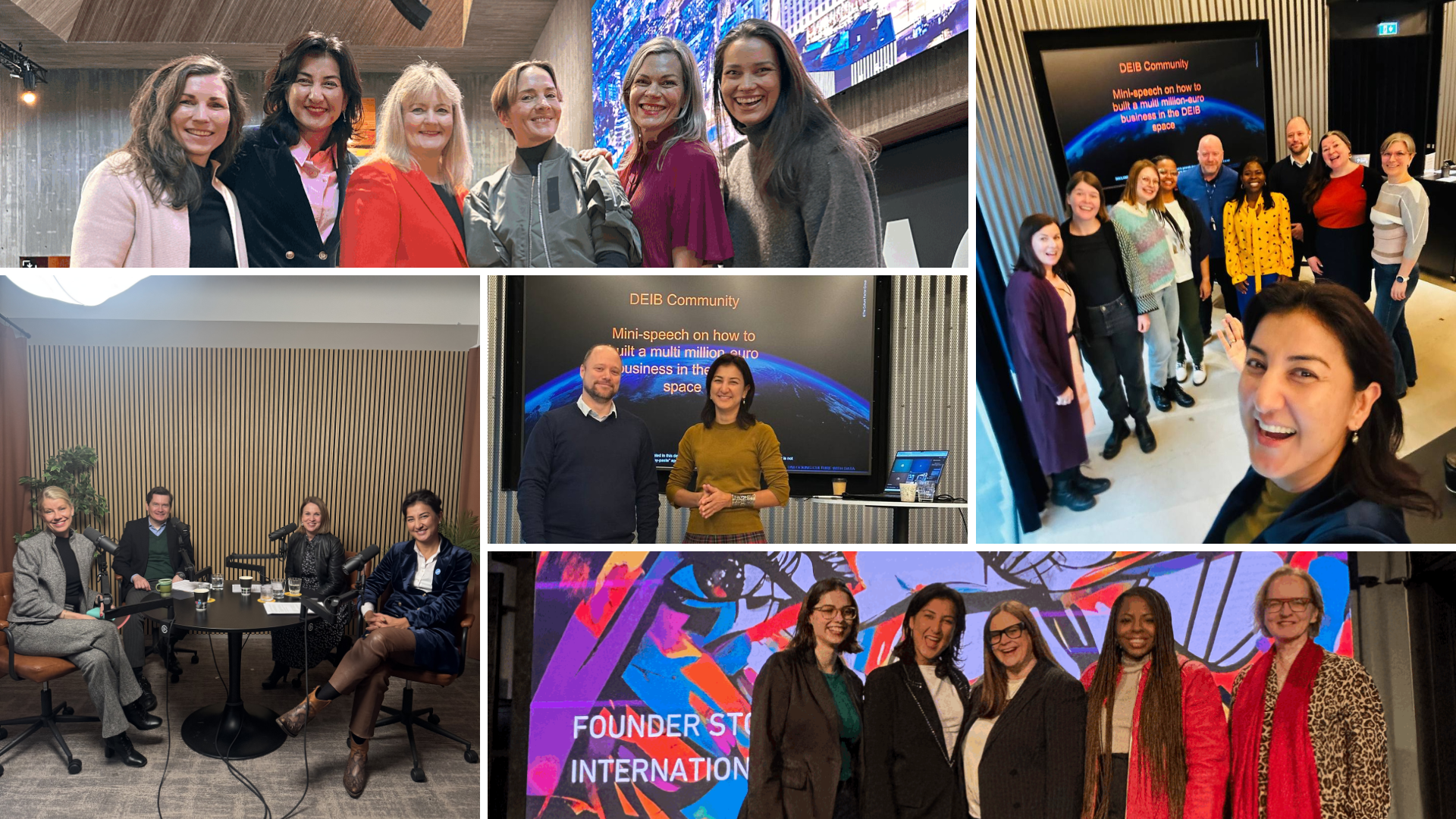
With Kaius Niemi and Susanna Takkunen (CEO, Accenture Finland)
We sat down to record a conversation hosted by Henley Business School Nordic on what the future of DEI actually means. Not the acronym. Not the slogan. The substance underneath: accountability, resilience, and readiness in an unpredictable world.
This was a particularly important conversation for me to be in.
The pendulum is swinging. Programmes are being cut, terminology is being rewritten, and many of the leaders I work with are quietly wondering whether the work still has a future at all. My answer is yes – but only if we let it evolve. The next chapter of this work is less about declarations and more about whether organisations are actually prepared to perform under pressure, retain talent, and make decisions that hold up over a decade.
Sitting alongside Kaius Niemi and Susanna Takkunen, two leaders who think at the scale of media and consulting respectively, sharpened me. I came out of that recording with a clearer language for the work ahead. That, on its own, was the value.
2. DEIB workshop with Egbert Schram
This one was pure craft maintenance.
Egbert Schram runs some of the most rigorous workshops on culture, organisational behaviour and DEIB practice in the Nordic region, drawing on the Hofstede tradition and his own decades of cross-cultural consulting. I went as a learner. Notebook open. Asking questions. Shutting up.
I do this on purpose, regularly. Anyone who facilitates rooms for a living and isn’t also sitting in other people’s rooms as a participant is, sooner or later, going to repeat themselves.
A few things I’m taking back into my own practice from Egbert’s session:
- The discipline of distinguishing what is cultural from what is merely personal, and why so many DEIB initiatives stumble at exactly that distinction.
- The importance of designing interventions that survive contact with reality, not just with a strategy slide.
- A renewed respect for the slow work of behaviour change versus the fast work of policy change.
If you ever get the chance to be in a room he’s running, take it.
3. Think Corner – Women’s Health and Wellbeing
On 6.3, I’ll be at Think Corner (Tiedekulma) at the University of Helsinki for an evening focused on women’s health and wellbeing.
I’m grateful to Aino Försti-Smith for putting this critical agenda on the calendar, and I’m looking forward to hearing from Aura Pyykönen, Maria Veitola, and Mikko Heikkinen.
People sometimes ask why I bother with topics that aren’t directly tied to whatever stage I’m hosting that month. Here’s why: women’s health is workforce strategy. It is leadership pipeline. It is retention. It is economics. The organisations that figure this out in the next five years will outperform the ones that don’t, quietly, but decisively.
I show up to these conversations because the work I do for clients tomorrow depends on the questions I’m willing to sit with today.
4. Epicenter Helsinki – Founder Stories Afterwork
That same evening, Epicenter Helsinki’s Founder Stories Afterwork brings founders and senior leaders together for conversations that challenge “business as usual.” Big shoutout to Joey Bayer for keeping this annual gathering alive, it is one of the more honest rooms in the city.
I move between corporate, public-sector and institutional spaces in my day-to-day work. Founder rooms keep me sharp on a different frequency: speed, risk tolerance, blunt feedback, the willingness to start something before the strategy deck is finished. I take all of that back with me into the boardrooms I work in.
Cross-pollination is not a buzzword for me. It’s a working method.
What ties these four rooms together
Look at the list again.
A podcast on the future of organisational accountability. A workshop on culture and behaviour. An evening on women’s health. A room full of founders.
These look like four different topics. They aren’t. They are four different doors into the same question I keep working on:
How do we design organisations and gatherings where people actually want to belong, contribute, and stay – under pressure, across cultures, over time?
That is the question my keynotes, my hosting work, my facilitation, and my organisational consulting all orbit around. The rooms above are where I keep recharging the answer.
A note for organisations who book me
If you’ve ever wondered what differentiates a moderator who reads the brief from a moderator who reshapes the conversation – this is the difference. It’s not charisma. It’s not stage time. It’s the unpaid hours.
It’s the podcast you did because the conversation mattered. It’s the workshop you took notes in. It’s the evening you spent with founders instead of on the sofa. It’s the women’s health panel you went to even though no one was watching.
I bring all of that into every event I host, every team I facilitate, every keynote I deliver, and every organisation I consult with on building a real community internally.
If that’s the kind of practitioner you want in your room, paid or otherwise, let’s talk.
With thanks to Henley Business School Nordic, Kaius Niemi, Susanna Takkunen, Egbert Schram, Aino Försti-Smith, Aura Pyykönen, Maria Veitola, Mikko Heikkinen, Joey Bayer and Epicenter Helsinki – for being the rooms worth showing up to.